


The 5-Minute Daily Reflection: A Checklist for Busy Evenings
The notebook is on the shelf where you left it in January. You had good intentions then, and you still do, which is why the sight of it produces a small, specific guilt at the end of a long day. A page of reflection sounds like a reasonable thing to want. It also sounds like one more task, and by nine in the evening the list of tasks is usually closed.
Five minutes is a different offer. Short enough to survive a bad day, specific enough that you don't have to invent it from scratch, structured enough that you close it feeling lighter rather than behind. What follows is a checklist — six moves, always in the same order — that fits between the last plate and the light switch.
Why Five Minutes Is Enough
Reflection is not measured in pages. It is measured in attention. Ten minutes of writing that you dread and postpone for three weeks is worth less than four honest minutes at the kitchen counter with the kettle on.
Long journaling sessions fail for a quiet reason: they demand a mood. They ask you to be calm, unhurried, articulate, and slightly philosophical — which is precisely what an ordinary Tuesday evening does not provide. A five-minute checklist asks almost nothing. It gives you a shape, and the shape does the work.
Think of it as tidying one surface instead of the whole house. You do not clear the desk because the room will then be finished. You clear it because a cleared surface changes how the next hour feels. Small, repeating contact with your own day is what builds the habit. Depth tends to arrive on its own, on the evenings when something actually needs saying.
Before You Begin: Make a Small Container
The checklist only works if it has edges. Set them before you start, or the five minutes will quietly become forty and then stop happening altogether.
- A timer, set visibly. Five minutes, not "about five." The boundary is what makes it repeatable.
- One surface only. A single note on your phone, one index card, or one page in a notebook. Never two.
- Phone on silent, face down. Not for discipline — for the simple reason that a notification will replace your train of thought with someone else's.
- No editing. You are not writing for a reader, not even a future version of yourself. Fragments count. Half-sentences count.
The Checklist
Go in order. If you run out of time, stop where you are and pick up there tomorrow — the sequence matters more than the completion.
- Name the day in one line. Not a summary, a label. "The day of the delayed train." "The day I finally replied." One line forces you to decide what today actually was, rather than listing everything it contained.
- Mark one moment that had weight. It does not have to be significant. A sentence someone said, a corner of light on a wall, the two minutes you stood still in a corridor. Weight is the test, not importance.
- Notice what you are still carrying. An unfinished email. A tone in a meeting. A conversation you rehearsed in the shower. Name it in three words and move on — naming is not the same as solving.
- Ask what you gave. Attention, patience, a lift home, a decent question, the last slice. Most days contain at least one small offering, and almost nobody counts them.
- Find one thing that worked. Something you would do again. This is not gratitude practice and it does not require enthusiasm; it requires accuracy.
- Set one thing down. One item from step three, named and formally parked: "Tomorrow, ten o'clock." Or simply "not tonight." Say it, write the words, and let the day end without it.
What is still warm from today?
Two Moves Worth Slowing Down For
Most of the checklist can be done quickly. Two of the steps reward a slower pass, especially on days that felt shapeless.
The one-line rule
The temptation in step one is to write a paragraph. Resist it. A paragraph gives you room to hedge, and hedging is how a reflection turns into a report you will never read again. One line, written badly, still tells you something. Keep the line and skip the paragraph.
Name what you are carrying, do not solve it
Step three goes wrong when it becomes problem-solving at nine in the evening, which is the worst possible hour for it. You are not deciding how to handle the difficult colleague. You are noting that the situation is in your bag. Closing the notebook with the thing still unresolved is allowed and often correct.
When the Evening Is Too Heavy for a Checklist
Some days do not fit into six short steps. On those evenings, do the first line and the last line — name the day, set one thing down — and leave the middle empty. That is not a failed session. It is the shortest faithful version of the same act.
If a difficult evening keeps repeating, or if the same worry arrives every night with the same force, a five-minute checklist is not the right tool for it. Talk to someone: a friend, a doctor, a professional who can look at the whole picture rather than one page. A small reflection habit is a good companion to real support, never a substitute for it.
Keeping It From Becoming a Chore
- Attach it to something you already do. After the dishes, before the last light goes off, while the tea steeps. A checklist with a fixed home gets used; one that floats gets forgotten.
- Keep the same six prompts. Novelty is overrated here. Repetition is what lets you notice changes in the answers.
- Miss a night without ceremony. No catching up, no double sessions. Tomorrow's five minutes do not need to know about yesterday's.
- Re-read once a month. Fifteen minutes with four weeks of one-liners will tell you more about your life than any single long entry.
Tonight, Before the Light Goes Off
Put the notebook where you will actually see it — by the kettle, on the charger, on top of the book you are not reading. Set a five-minute timer. Write the one line about today, mark one moment with weight, and set one thing down.
Then close the page. You have not analysed your life, and you were never asked to. You have simply looked at the day while it was still close enough to see, and put it away on purpose rather than by exhaustion. That is the whole practice. Six small moves, five minutes, and a slightly quieter walk to the light switch.
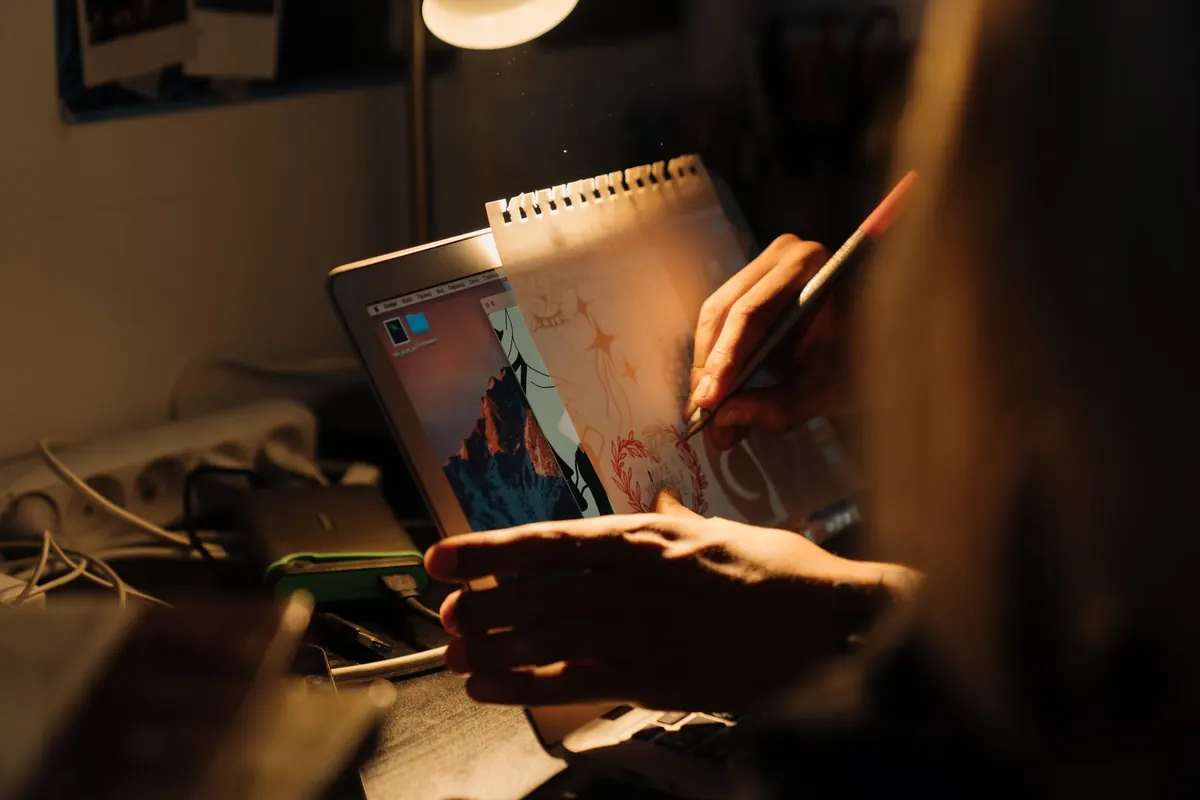
Photo: cottonbro studio / Pexels